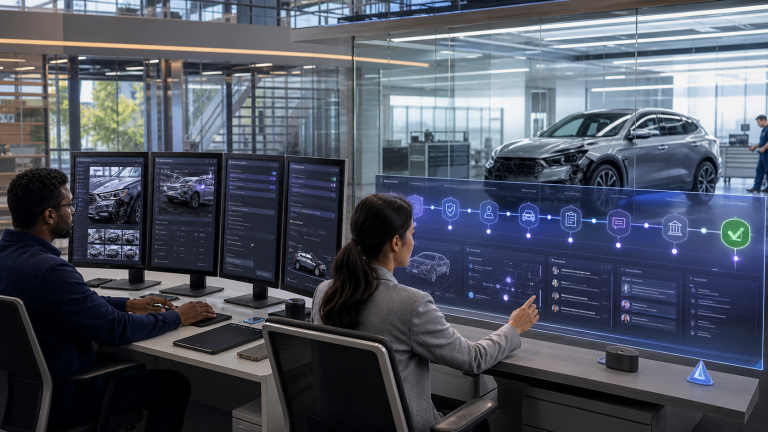
Trade finance teams often spend significant time comparing letters of credit with invoices, bills of lading, insurance documents, packing lists and certificates.
The difficulty is not simply reading each document. It is establishing whether the documents, taken together, comply with the credit.
Under UCP 600, banks examine the presentation against the credit, the applicable rules and the documents presented. They have a maximum of five banking days following presentation to determine whether the presentation is complying.
That creates a time-sensitive operational problem when much of the comparison is still manual.
Why does letter of credit document checking take so long?
The same information can appear in several places.
Shipment dates may appear in transport and insurance documents. Names, ports, quantities, currencies and goods descriptions may need to be compared across the credit, invoice and shipping documents.
The examiner therefore spends time locating information, normalising differences in format and identifying conflicts before reaching the point that requires professional judgment.
The operational bottleneck is often cross-document comparison before the compliance decision can even be made.
Similar fragmentation appears in other regulated banking workflows. In The Hidden Cost of Fragmented Customer Onboarding, we look at how manual coordination between systems, validations and compliance stages creates the same type of operational delay.
Which letter of credit checks can be automated?
A document workflow can classify incoming documents, extract relevant fields and organise them around the presentation being examined.
Rule-based checks can compare:
required documents against documents received;
shipment and presentation dates against credit conditions;
amounts, currencies and quantities across documents;
names, ports and references;
information repeated across invoices, transport and insurance documents;
missing signatures, endorsements or required fields.
AI Enterprise Automation can coordinate these checks across the wider process, while document extraction and validation prepare a structured view for review.
The examiner can then focus on the areas where documents conflict or interpretation is required instead of reconstructing the presentation manually.
Can trade finance compliance decisions be fully automated?
Some checks are deterministic. Others depend on international standard banking practice and context.
UCP 600 does not require data in different documents to be identical. It requires that the data does not conflict with the credit, the document itself or other stipulated documents.
Automation should therefore surface potential discrepancies and supporting evidence while the trade finance specialist retains responsibility for the compliance decision.
Where legacy applications do not expose the required integrations, RPA can handle specific rule-based system actions without becoming the architecture of the entire review process.
How DigiTech Consult approaches trade finance document review
DigiTech Consult designs the workflow around the existing examination process.
Document data can be classified and extracted, validation rules can compare information across the presentation, and exceptions can be routed to the appropriate specialist. System integration connects the review with existing trade finance, document management and internal banking systems.
Our work with document-heavy processes in other industries follows the same principle. The Mr. Bricolage automation programme began in an environment processing more than 84,000 incoming documents annually, where automation was introduced around the existing operational process rather than as a standalone tool.
Trade finance document automation creates value when repetitive comparison work is completed before the examiner needs to intervene.